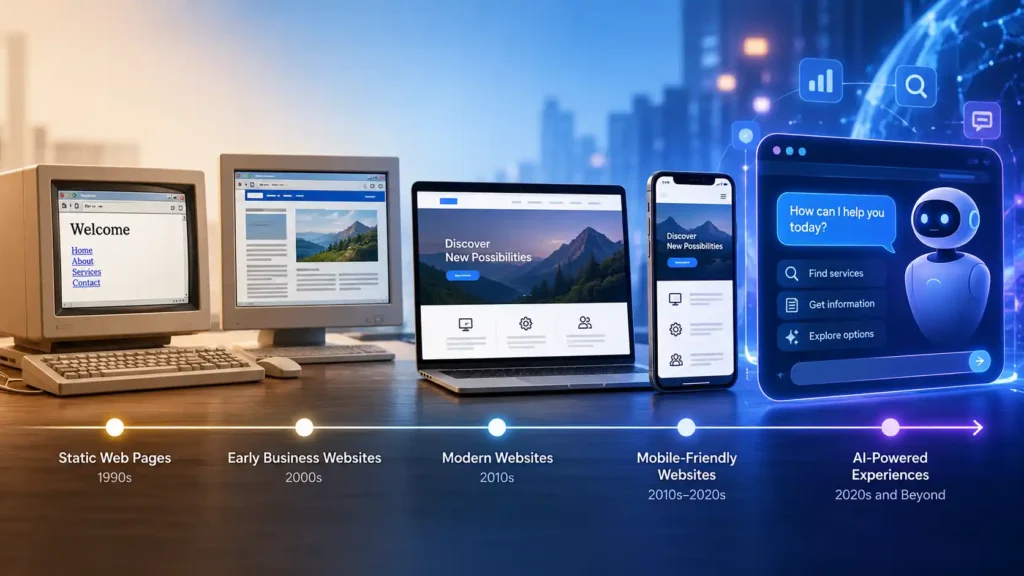
“The internet keeps changing, and every change creates new ways for people and businesses to connect.”
Do you remember when websites were just simple pages with text and a few links? Today, we use websites to shop, learn, book services, communicate, and run entire businesses. Some websites even use artificial intelligence to answer questions and help visitors find what they need.
The evolution of websites is not just about better designs or faster technology. It is about how people use the internet and how businesses adapt to changing expectations.
Let’s look at how websites have evolved and what the future may hold.
1. The Early Days of Websites
In the early 1990s, websites were mostly simple HTML pages created to share information. They contained text, basic links, and a few images. The first website, developed by Tim Berners-Lee at CERN, introduced a new way to access and connect information.
Businesses soon realised that a website could act as an online brochure, displaying company details, products, services, and contact information.
These early websites were basic, but they laid the foundation for today’s digital world.
2. The Rise of Dynamic and Interactive Websites
As web technologies improved, websites became more interactive. Databases, JavaScript, and server-side programming made it possible to build websites where visitors could register, search, submit forms, and make online payments.
E-commerce websites changed the way people shop. Businesses could now sell products to customers across different cities and countries without opening physical stores everywhere.
Content management systems such as WordPress also made website creation easier. People could publish articles and manage website content without needing advanced coding skills.
Websites had become more than digital brochures. They were now important business tools.
3. Mobile-Friendly Websites and SEO
The growth of smartphones changed the way people accessed the internet. Businesses needed websites that worked properly on mobile phones, tablets, and desktop computers.
Responsive web design helped solve this problem by allowing websites to adjust to different screen sizes.
At the same time, search engine optimization (SEO) became essential. As millions of websites competed for attention, businesses needed to make their content easier to discover through search engines.
Website speed, useful content, mobile usability, descriptive headings, and clear navigation became important parts of a successful online presence.
Even today, a well-designed website needs more than an attractive appearance. It must also provide useful information and a good experience for visitors.
4. How Artificial Intelligence Is Changing Websites
Artificial intelligence is introducing a new phase in website development.
AI-powered chatbots can answer customer questions, explain services, and help visitors find relevant information. Businesses can also use AI tools to assist with customer support, content creation, and website analysis.
More importantly, AI is changing how people discover businesses online.
Instead of searching only for keywords, people increasingly ask AI assistants questions such as, “Which digital marketing agency can help a small business improve its online presence?”
This creates new opportunities for businesses to make their websites more informative and easier to understand.
Clear service descriptions, accurate business details, helpful FAQs, descriptive headings, and structured data can help search engines and other systems interpret website information. However, no single technique guarantees that an AI chatbot will recommend a particular business.
5. Why AI-Friendly Websites Matter
Traditional SEO focuses on helping search engines discover and understand website content. Today, businesses also need to consider how AI-powered search tools and chatbots access and interpret online information.
An AI-friendly website should have:
- Clear and accurate information about the business.
- Separate pages for important products and services.
- Simple headings and well-organized content.
- Useful answers to common customer questions.
- Fast loading speeds and mobile-friendly design.
- Descriptive page titles and appropriate structured data.
These practices help make website information easier to understand for both people and automated systems.
Business directories can also play a role by organizing company details, services, and contact information in a useful format.
At AI Direct, the aim is to make discovering businesses and services easier in a digital world where AI-assisted discovery is becoming increasingly important.
6. Will AI Replace Websites in the Future?
As AI assistants become more capable, some people wonder whether traditional websites will still be necessary.
The answer is likely to be yes, although the way people use websites may change.
An AI assistant might recommend a company, but a customer may still want to visit its website to check its portfolio, compare services, read detailed information, or contact the business.
A website also gives a business greater control over its digital presence, branding, and published information.
In the future, websites may work more closely with AI assistants, automated agents, and other digital services. Some customer interactions may happen through conversational interfaces rather than traditional browsing.
Businesses that provide accurate information, useful content, and a good user experience will be better prepared for these changes.
Conclusion
The evolution of websites has taken us from simple HTML pages to dynamic platforms, mobile-friendly experiences, and AI-powered services.
Technology will continue to change, but the basic purpose of a website remains the same: to provide useful information, connect with people, and help businesses serve their customers.
For businesses, the next step is not simply to build a website. It is to make that website informative, trustworthy, accessible, and ready for changing ways of discovering information.
AI-powered search and chatbots are opening new possibilities for online discovery, and businesses should start preparing for this shift.
What do you think? Will AI completely change the way people discover websites, or will traditional websites remain the most important part of a business’s online presence?